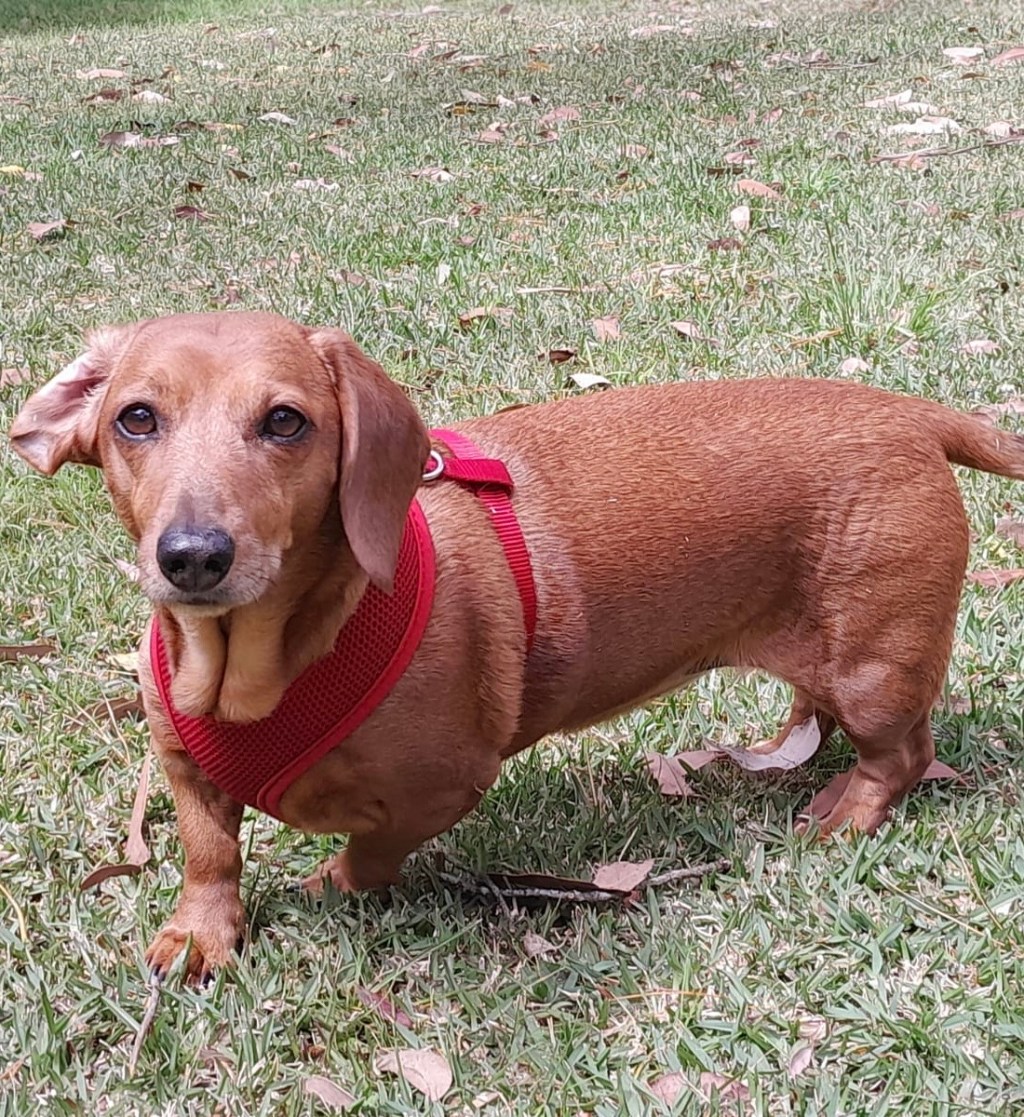
Dachshund facts · 10 min read
10 Things I Guarantee You Don’t Know About Dachshunds
Not even if you’re a hardcore fan like me.
By Snooty McSausage’s Human
Dachshunds, wiener dogs, sausage dogs, hotdogs, long dogs, teckels, doxies, dashies — whatever you call these ridiculous little animals, you probably think you know everything about them. You’ve got the ramp. You’ve heard about IVDD. You know they’re stubborn (sorry — “independent thinkers”).
But I promise you, at least a few of these will be news. I’ve been owned by two rescue dachshunds for several years now, and I’m still learning things that surprise me. Here are ten of my favourites.
1. They were literally bred to fight badgers
You know the name “dachshund” means “badger dog” in German. But do you really understand what that means? These five-kilo sausages were bred to crawl into underground badger dens — in the dark, alone — and either drag the badger out or hold it at bay until the hunter dug down. Badgers, for the record, are vicious. They have claws like small garden rakes and a temperament that makes your dachshund’s reaction to the postman look positively zen.
This is why your dachshund digs in the garden, burrows under your doona, and disappears into your laundry pile. It’s not naughty. It’s six hundred years of breeding screaming “GO UNDERGROUND.” Every time McKenzie tunnels into my duvet at 2am, I remind myself: she was designed for this. I was not designed for being woken up by a cold nose in my armpit, but here we are.
2. There are actually fifteen varieties (not three, not six — fifteen)
Most people know dachshunds come in three coat types: smooth, long-haired, and wire-haired. And some know there are two sizes: standard and miniature. So that’s six varieties, right? Wrong. In Europe and under the FCI breed standard (which Australia follows through Dogs Australia), there’s a third size: the Kaninchen, or Rabbit dachshund. Smaller even than a miniature, the Kaninchen was bred to hunt — you guessed it — rabbits down their burrows. Three sizes times three coat types gives you nine varieties. But then factor in the range of recognised colour patterns — red, black and tan, chocolate and tan, dapple, brindle, piebald — and you’re well into double digits.
McKenzie is a smooth-coated standard red. Elodie is a long-haired miniature shaded cream. If I ever get a wire-haired (those adorable whiskery faces!), I’ll have the full set and will probably need to be formally inducted into some kind of registry.
3. Their bark is the same decibel level as a much, much larger dog
If you own a dachshund, you already know this in your bones (and your neighbour probably knows it too). But the science backs it up: a dachshund’s bark registers between 80 and 100 decibels. That’s roughly the same as a German Shepherd’s bark, and comparable to a motorcycle or a food blender at full speed.
This is not a design flaw — it’s a feature. When your dachshund was down a badger hole in 1500s Germany, the hunter above ground needed to hear them barking to know where to dig. A quiet dachshund was a useless dachshund. So, congratulations: your dog is performing exactly as intended. Explain that to your neighbour.
4. IVDD isn’t just about jumping off the couch
Here’s where most dachshund owners have a dangerous gap in their knowledge. You know about Intervertebral Disc Disease. You’ve bought the ramps. But IVDD in dachshunds isn’t caused by jumping — it’s a degenerative condition they’re genetically predisposed to because they’re chondrodystrophic (a fancy word meaning they have a form of dwarfism that affects cartilage development).
What actually happens: the gel-like discs between their vertebrae start to calcify and harden from as young as four months old. Over time, these hardened discs lose their shock-absorbing ability and become brittle. A jump, a twist, or sometimes just a bad step can cause a calcified disc to rupture, pressing on the spinal cord.
The bit most owners don’t know? You can’t prevent IVDD — it’s happening in their discs whether you have ramps or not. What you can do is reduce the risk of a rupture event. That means weight management, core-strengthening exercise (swimming is brilliant), avoiding high-impact activities, and knowing the early warning signs. Roughly 25% of all dachshunds will experience a disc event in their lifetime. Read our full IVDD guide here.
5. They have a scent-tracking ability second only to bloodhounds
Your sausage dog’s nose isn’t just cute — it’s extraordinarily powerful. Dachshunds have approximately 125 million scent receptors (humans have about 5 million), and among dog breeds, they’re considered second only to the Bloodhound for tracking ability.
This is why your dachshund goes completely deaf when they’ve picked up a scent on a walk. They’re not ignoring you — well, they are, but it’s because every fibre of their being is locked onto that smell. If your dachshund’s nose hits the ground and their tail goes rigid, just accept that you’re going to be standing in that spot for the next three minutes. They’re working.
6. They’re one of the most popular dog breeds in Australia (and always have been)
Dachshunds consistently rank in the top 10 most popular breeds in Australia, and in some years, the top 5. The dachshund community is one of the most engaged breed communities in the country, with active Facebook groups, breed clubs in every state, regular meetup walks, and even dedicated dachshund racing events (which are hilarious and deeply chaotic).
The pandemic saw a surge in dachshund adoptions, with many first-time owners drawn to their small size and apartment-friendly reputation. Which is how a lot of people discovered that “small” and “easy” are not the same thing. There’s nothing easy about a dachshund. That’s (part of) why we love them.
7. Separation anxiety isn’t just clinginess — it’s a breed trait
If your dachshund follows you from room to room, sits outside the bathroom door, and melts down when you leave the house, that’s not just your dog being needy. Dachshund separation anxiety is well-documented and significantly more common in this breed than most others. (And if they don’t do any of these things, are you sure you got a dachshund?)
They’re partnership dogs. They were literally designed to go into a dark hole and trust that their human would be right there, digging from above. When you leave, they don’t understand that you’re coming back. They just know their partner is gone. Read our full guide to managing separation anxiety.
8. Miniature dachshunds were created to hunt rabbits in France
The standard dachshund was Germany’s badger hunter. But when the French wanted a version that could pursue rabbits down their much smaller burrows, they selectively bred for smaller size, creating what we now know as the miniature dachshund. The Kaninchen (rabbit) dachshund went even smaller. In Australia, the distinction is based on weight (miniatures are under 5kg), but in Europe, it’s measured by chest circumference — because what actually mattered was whether the dog could fit down the hole.
Elodie, my miniature long-haired, weighs about 4.5kg. She has never met a rabbit. She has, however, attempted to dismember many, many squeaky toys.
9. A dachshund was the first Olympic mascot
The 1972 Munich Olympics chose a dachshund named “Waldi” as the official Olympic mascot — the first time any Olympics had a mascot at all. Waldi was a long-haired dachshund, designed in rainbow colours by the artist Otl Aicher. The marathon route that year was even designed to trace the shape of a dachshund when viewed from above.
Germany has always had a deep cultural connection with dachshunds. Kaiser Wilhelm II was famously obsessed with them. Picasso had one named Lump who appears in several of his paintings. Andy Warhol had two — Archie and Amos — who reportedly attended studio meetings. Your dachshund might not be hanging out with Picasso, but don’t tell them that. They already think they’re the most important being in the room.
10. Rescue dachshunds are wildly underrated
I didn’t set out to get a dachshund. McKenzie came into my life through rescue, and Elodie followed not long after. Both were adults, both came with their own stories, and both have changed my life in ways I didn’t know I needed.
The assumption many people make is that rescue dogs are “damaged” or “difficult.” McKenzie came from a loving home. So loving, in fact, that she apparently used to get a baked dinner every night! My baby, Elodie, was likely the product of a backyard breeder and came to me skin and bones, scared of everything and with a terrified banshee howl. However, once they trust you, adopted dachshunds are capable of a bond that’s almost uncomfortably intense. And there’s something so heart-melting about the dog who doesn’t trust anyone coming to you for comfort.
If you’re thinking about adding a dachshund to your family, please consider rescue. Organisations like Dachshund Rescue Australia and PetRescue (where I found both my girls) always have dachshunds or dachshund mixes looking for homes. These dogs aren’t broken. They’re just waiting for their person.
And take it from me — sometimes the best things in life are the ones you didn’t plan.
Written with love (with two dachshunds by my side) from the Ngurra (Country) of the Dharug and Gundungurra peoples, AKA the Blue Mountains, NSW.
Want more dachshund content?
Subscribe to A Letter from Snooty McSausage — a fortnightly newsletter about dachshund health, product reviews, rescue stories, and the general absurdity of life with sausage dogs. Plus get the Dachshund Back Care Bible free.
 Snooty McSausages
Leave a comment