Health · 8 min read
The Honest Guide to IVDD: What Every Dachshund Owner Actually Needs to Know
Forget the scare stories. Here’s a clear-eyed look at intervertebral disc disease — risk factors, early signs, and what the research actually says about prevention.
By Snooty McSausage’s Human
If you’ve just got a dachshund — or you’re thinking about getting one — you will have already encountered the acronym IVDD. Probably in a Facebook group comment. Possibly in a slightly terrifying thread full of wheelchairs and recovery timelines that sent you down a 2am rabbit hole of anxiety.
I’ve been there. Most of us have.
Here’s the thing: IVDD is real, it’s common in dachshunds, and it’s absolutely worth understanding. But most of what gets shared about it online is either medically incomplete, catastrophically scary, or both. What you actually need is a clear, honest explanation of what it is, what causes it, what reduces the risk, and what to do if something goes wrong. That’s what this is.
What is IVDD?
IVDD stands for Intervertebral Disc Disease. It’s a condition affecting the discs that sit between the vertebrae of the spine — the cushion-like structures that absorb shock and allow the spine to flex and move. In a healthy spine, each disc has a tough outer ring surrounding a soft, gel-like centre. Together, they act like a little shock absorber.
In dachshunds, those discs can deteriorate, harden, and eventually rupture — pressing on the spinal cord. Depending on where the rupture is and how severe it is, the result can range from back pain to partial or complete paralysis. Which sounds alarming. But here’s the important context.
Why dachshunds specifically?
Dachshunds are chondrodystrophic — a word that means they carry a genetic mutation affecting cartilage development. It’s the same mutation that gives them their signature long, low shape. Short legs. Long body. Enormous personality. And, as a trade-off, intervertebral discs that are prone to premature degeneration.
In chondrodystrophic dogs, the gel centres of the discs begin to mineralise — to calcify and harden — from as early as four months of age. By the time your dachshund is two or three years old, many of their discs may already be significantly changed. This is not caused by jumping off the sofa. It’s not caused by running too fast. It’s happening in their discs regardless, as part of their biology. What jumping and impact can do is trigger a rupture event. But the underlying change was already there. This distinction matters, because it changes how you think about prevention.
How common is it?
Approximately one in four dachshunds will experience a clinically significant disc event during their lifetime. That’s high enough that every dachshund owner genuinely needs to know about this. It also means three in four dachshunds won’t have a significant event. Many dogs with calcified discs live long, active, comfortable lives. The goal of everything in this article is to keep your dog in that group — and to help you respond quickly and well if they’re not.
What actually increases the risk?
You can’t prevent the underlying disc changes — that’s genetic. But you have more influence over rupture risk than you might think.
Weight
This is the big one. Extra body weight puts additional compressive load on already-compromised discs. A dachshund who is even half a kilogram overweight is carrying proportionally more strain on their spine than a heavier breed would. Weight management isn’t about aesthetics. It’s about spine health.
High-impact repetitive movement
A single jump off the couch won’t cause a disc event. But thousands of jumps over years do accumulate. Ramps and steps for furniture access are a genuinely worthwhile investment — not because of any single incident, but because of the cumulative load they prevent.
Muscle weakness
The muscles around the spine act as a support system. A dachshund with strong core muscles has better spinal protection than a sedentary one. Appropriate exercise — particularly swimming — genuinely helps.
Twisting and high-intensity play
Repetitive sharp direction changes, sudden starts and stops, rough wrestling — these put rotational stress on the spine. A bit of play is fine and healthy. Daily high-intensity ball chasing is worth moderating.
What doesn’t increase the risk?
Normal daily life. Walks. Sniffing. Being a dog. There’s a tendency in dachshund communities toward well-meaning but counterproductive over-restriction. A dachshund who is kept from normal movement becomes deconditioned, which actually weakens the muscular support around the spine. The goal is smart management, not bubble-wrapping.
Signs something might be wrong
Dachshunds are stoic. They hide discomfort, especially early on. By the time they’re obviously distressed, things have often been building for a while.
Early, subtle signs:
- Hesitating before using a ramp or steps
- Slower or more careful when getting up or lying down
- Slight stiffness that eases after movement
- Not stretching the way they usually do
- Tail carried lower than normal, or less waggy
- Reluctance to be touched in certain ways
More concerning — see a vet within 24 hours:
- Crying or whimpering when moving
- A visibly hunched or tense back
- Wobbly or uncoordinated rear end
- Reluctance to jump or use stairs they normally manage
- Any sudden change in how they move
Emergency — go immediately:
- Cannot use back legs
- Dragging hindquarters
- Loss of bladder or bowel control
- Sudden collapse or rapid deterioration
Time matters enormously with spinal injuries. Don’t wait to see if it gets better on its own.
What happens if there is a disc event?
Vets assess IVDD severity on a grading scale from 1 to 5. Grade 1 is pain only; Grade 5 is complete paralysis. Conservative management — strict rest, anti-inflammatories, pain relief, close monitoring — is often the first approach for milder cases. Surgery is recommended for higher grades, dogs who don’t respond to conservative management, or when rapid deterioration is occurring. In appropriate candidates, surgery has excellent outcomes. Earlier is better.
If your dog has a significant disc event, ask for a referral to a veterinary neurologist if at all possible. Recovery takes time — weeks to months — and often involves strict crate rest. Physiotherapy and hydrotherapy can significantly support recovery.
The bottom line
IVDD is not a reason to panic. It’s a reason to be informed. Know your dog’s normal. Keep their weight healthy. Install the ramps. Swim them when you can. And if something changes — if your gut says something’s off — call your vet. You know your dog better than anyone.
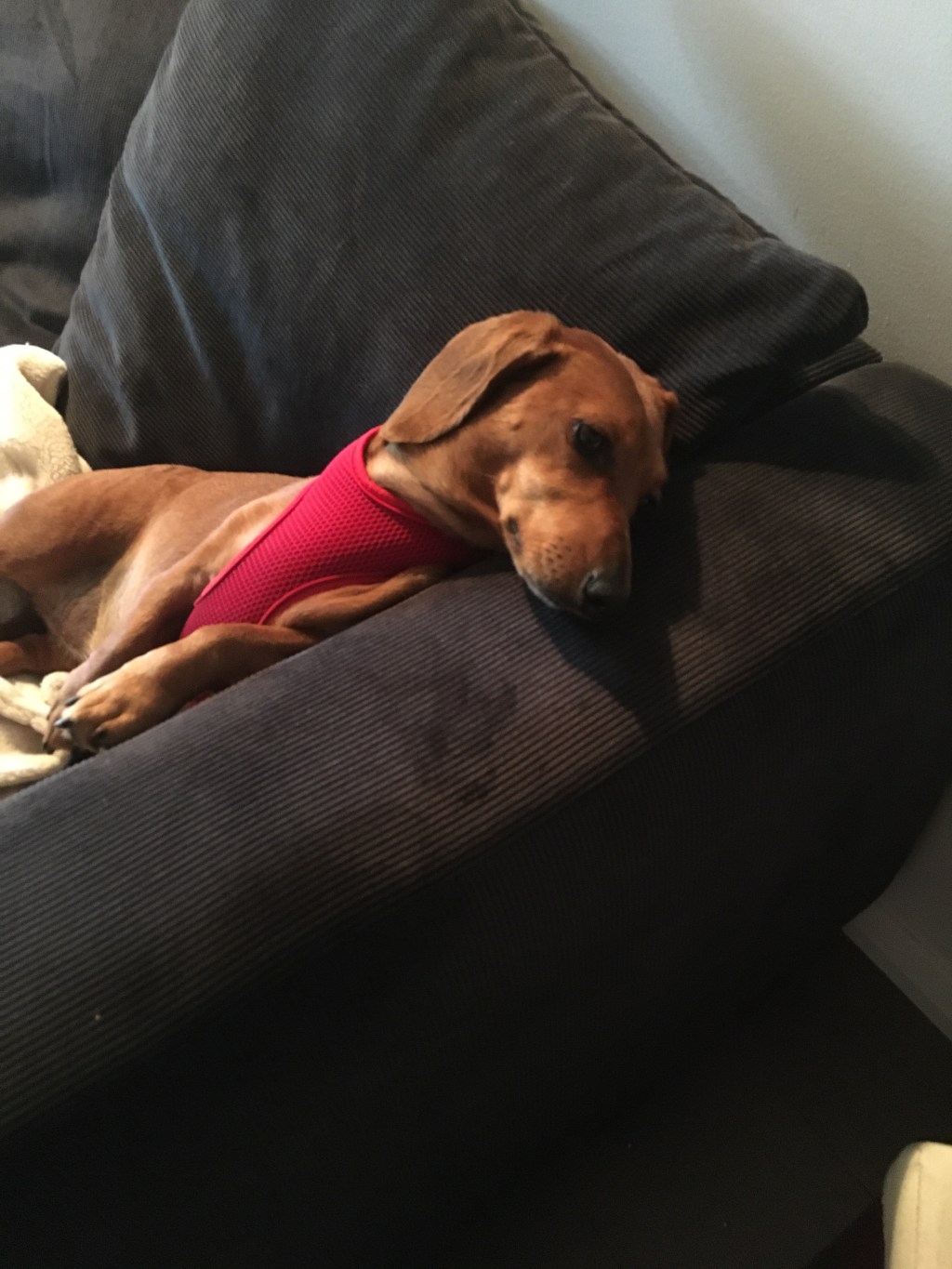
McKenzie is a smooth-coated standard dachshund, currently on a vet-supervised diet and with strong opinions about it. Elodie is a long-haired miniature cream dachshund who arrived underweight and underdeveloped and has since become the most enthusiastic eater in the household. Both of them inspired this article.
Want a deeper dive?
Download The Dachshund Back Care Bible — free when you subscribe to A Letter from Snooty McSausage. It includes a daily spine check routine, home setup guide, exercise recommendations, and what to do if something goes wrong.


Leave a Reply